Phoebe Fisher is live! The paperback edition will be available on June 15th, 2022.
History, mystery and love. Links and leads to stories of romance and comments on a writer's life.
Friday, June 3, 2022
Wednesday, January 19, 2022
An Invitation to . . .
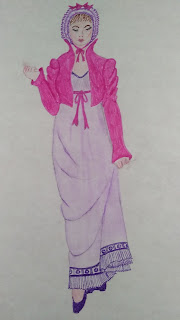
. . . Phoebe's wedding. Regency weddings were far simpler events than they often are today. Members of the ton, the upper echelons of society, married at St. George's Parish Church, located in Mayfair. As many as three ceremonies a day took place there, which did not give much time between one couple and the next. So there was no decorating the church as is often the way these days. The white wedding gown that is so much the hallmark of modern weddings did not become popular until Queen Victoria married Prince Albert on the 10th of February 1840.
But back to Phoebe. For a simple family wedding, there would be very few in attendance. The minister and clerk, bride and groom, their parents, and their friends. The bride might have had a bridesmaid and the groom a best man. These would have also stood witness to the marriage. The bride might have worn her best dress, sometimes, her only dress and a light meal would have been served in the bride's home.
Phoebe's father and aunt insist that she have a new outfit for her wedding. For this, I made use of illustrations in Tom Tierney's Fashions of the Regency Period Paper Dolls (Dover Publications Inc 1996.) I have never gone as far as cutting these out as the book is far more useful to me in its entirety.
I chose the jacket and bodice of one design and added it to the skirt of another. The spencer jacket is rose-pink crushed velvet, the gown is lavender satin with purple trim. Her frilled bonnet is trimmed with rose-pink crushed velvet ribbon, and she wears purple satin shoes.
Next week, I'll show you what her groom, Lord Andrew Fitzgibbon, will wear.
Thursday, January 13, 2022
What's New in 2022
So here I am, at it again. Writing, that is. The current work in progress is Those Regency Belles Book 3, Phoebe Fisher. Here's the premise:
Phoebe Fisher’s generous dowry attracts many suitors. When they discover Phoebe’s one notable and outstanding flaw, they depart as quickly as they arrive, and she loses hope of ever finding a suitor who will love her just as she is.
After an absence of ten years, Andrew Fitzgibbon returns home to discover he is the sole heir to his deceased uncle’s title and estates, but it will take a fortune to save it. Although reluctant to press his suit to a young lady simply for her wealth, Andrew finds her intriguing and suggests a union that might suit them both. Phoebe agrees, but then events from Andrew’s past cloud their new life together.
Will these threats make or break them? Will their marriage of convenience grow into a love match, or will Pheobe never know what it is to love and be loved?
Today I'm also designing Phoebe's wedding gown. I'll show you that next week.
Saturday, December 18, 2021
Family Experiences in My Writing
This month - the last of 2021 and let's hope they all improve by leaps and bounds in 2022 - Rhobin asked: How do your family experiences translate into writing scenes?
I had to think about
this topic as nothing immediately sprang to mind. What were my family
experiences? After thinking long and hard, one word came to mind –
movement. Nothing is static, but my family always seemed to be on the move in
one way or another. Post-WWII uncles and aunts in the forces were still coming
and going. Some were gone altogether, having lost their lives in that conflict.
My father, a career
soldier, was demobbed but couldn’t settle in civvy street and joined the army
again. Dad was posted from one Territorial Army unit to the next, and we moved
every year from one married quarters address to the next. Ironically his title
was Permanent Gunnery Staff Sarjeant Major to Territorial Units. Although the
title was permanent, there was nothing permanent about our family life.
When Dad finally left
the Armed Forces, we moved again to the job he took post-army. I moved on as
soon as I could to work with horses. The next move was to my parents-in-law’s
home, then into our first apartment, followed by another apartment when my then-husband
took a new job. Our next move was into a new house where we stayed put for a
few years. Unfortunately, that situation changed after separation and divorce.
New home, here we come. We landed up in a charming but chilly 300-year old
country house which was my favourite house of anywhere I have ever lived. After
that came another not as old house, but a mere stripling at 100-years old.
The next move was a big
one. I left England and arrived in Canada in 1990 but homes were never
permanent even here. What started as a reasonably comfortable apartment in one
building became inconvenient with job changes, making a move across town the
sensible thing to do. Since I’ve lived in Canada, I’ve had eight moves. I
never, ever imagined I’d become something of an expert in packing and moving.
This movement appears in all the books I’ve written.
https://www.smashwords.com/profile/view/chathambwl |
In Book 1 of the
Berkeley Square books, my first Regency series, Emmaline Devereaux has been in
Spain during the Peninsular Wars, and after returning home and marrying Lord
Lucius Clifton, is kidnapped and taken to France. In Book 2, Lady Juliana
Beamish is on her way to India when her ship is attacked by pirates.
She finds herself alone on the ocean and rescued by a captain who is on course
for Jamaica. Book 3 in the series finds Lady Olivia Darnley abandoned by her
mother, ultimately leaving London for the refuge of her family estate in
Lincolnshire.
My contemporary Western
romances have leading characters who move from one place to another. In Loving
That Cowboy, Trisha Watts leaves her home in England for a vacation in Calgary
during Stampede. Then, in Legacy of Love, Callie Wade moves from Vancouver to
Southern Alberta. In my Canadian Historical Brides book, Brides of Banff
Springs set in 1935, young Tilly McCormack makes her way from her home near
Medicine Hat to Banff to work at the famous Banff Springs Hotel. In Envy the Wind,
another title in the Canadian Historical Brides series and on which I collaborated
with author Anita Davison, Grace MacKinnon escapes from a life of drudgery in Edwardian
England and makes a life for herself in Prince Edward Island.
For my second Regency
series, Those Regency Belles, Hester Dymock in Book 1 moves only a few miles
from her small but comfortable home and faces much more of a journey than that.
Book 2 sees Charlotte Gray having to move for her safety, and in Book 3,
currently in progress, my heroine moves from her family home to that of the man
she marries. That her husband has served in King George III’s Royal Navy and
tells her tales of his travels makes this something of An Arabian Nights tale.
Other family experiences, which may be more family traits, are that my characters are for the most part kind, honest people. I hope those factors make them stand out a little more.
I wish you everything you wish for yourselves for this holiday season but before you go, please check out my fellow bloggers here for what family experiences they use for inspiration:
Anne
Stenhouse http://annestenhousenovelist.wordpress.com
Dr.
Bob Rich https://wp.me/p3Xihq-2ue
Connie
Vines http://mizging.blogspot.com/
Skye
Taylor http://www.skye-writer.com/blogging_by_the_sea
Marci
Baun http://www.marcibaun.com/blog/
Judith
Copek http://lynx-sis.blogspot.com/
Diane
Bator http://dbator.blogspot.ca/
Victoria
Chatham http://www.victoriachatham.com
Rhobin
L Courtright http://www.rhobincourtright.com
Saturday, November 20, 2021
The Baddie in Books
For this month, Robin has asked us to describe a flawed or evil character we have or might use in a story. How did they become so flawed? What part will they play in the story and what will happen to them?
I always have trouble creating evil characters. I
would say that most have mine have been flawed in some way rather than truly
evil. Except for, maybe, Sir Peregrine Styles in my first Regency romance, His
Dark Enchantress. Sir Peregrine was very much a depraved character,
particularly in the satisfaction he derived from causing pain or trouble to
others. He was a narcissist, manipulator, and opportunist all rolled into one
character but none of that was greatly surprising given the era and the mores of the strata of society
he grew up in.
People being people, and our characters are people if
only in our minds and books, good and bad can come from anywhere. The best of
families could have one bad apple. A family in the poorest area of town may
have a dad with a heart of gold and a mum who will do anything for her children
first and her neighbours after that.
People can and do change. Rose of Sharon in Steinbeck’s Grapes of Wrath spring to mind.
Circumstances can mold a person. Disappointment after disappointment may eventually turn a happy, positive person bitter and cause them to seek revenge against those he or she believes responsible. Being brought up in an abusive household may produce an abuser or someone who would never lift a finger against another person.As authors, building the backstory for a flawed or
evil character is as intriguing and circuitous as those of our main characters
and, dare I say, might take a bit more of a psychological twist. Writing
historical fiction means dipping into the social history of the period whether,
in my case, it is the Regency or Edwardian eras. The class structure was pretty
much adhered to. People ‘knew their place.’ But within that structure, the mores
of the Regency became stricter through the Victorian era and began to ease
again in the Edwardian era, especially the La Belle Epoch era in Europe which dated
from the early 1870s up until the outbreak of World War 1.
Regency characters who held ambitions to rise above
their place in society might be referred to as ‘mushrooms.’ The term ‘nabob,’
originally denoting an official under the Mughal Empire, came to be used
somewhat derisively for a pretentious person, especially one growing his own
wealth rather than inheriting it. After all, the definition of a gentleman then was someone who did not work for his living but off the wealth generated by his estates.
My current ‘baddie’ is one Ruby Baker in the third book, Phoebe Fisher, in my series Those Regency Belles. Ruby is a barmaid with took my hero’s promises to heart. In a drunken moment as an eighteen-year-old and about to embark on his first voyage, Andrew promised to bring her jewels from India. Ten years later, Ruby arrives on his doorstep to collect them. Why such a time span? Well, a voyage to India could take a minimum of four months. Depending on what happened during the voyage, pirates, storms, being blown off course, it could take a year. And then you turned around and possibly faced the same problems on the return journey. That was without any other detours. However, now Andrew has inherited a title and gained a wife. What will Ruby do? I’m still working on that.
Visit my fellow authors listed here and see what they are working on.
Anne
Stenhouse http://annestenhousenovelist.wordpress.com
Dr.
Bob Rich https://wp.me/p3Xihq-2ue
Connie
Vines http://mizging.blogspot.com/
Skye
Taylor http://www.skye-writer.com/blogging_by_the_sea
Marci
Baun http://www.marcibaun.com/blog/
Diane Bator http://dbator.blogspot.ca/
Rhobin L Courtright http://www.rhobincourtright.com
Saturday, October 23, 2021
Things That Go Bump in the Night
Our Round Robin leader asked us to share a childhood memory or scariest experience of October 31st. All Hallow’s Eve or Hallowe’en, the one night in the year when ghosts, ghouls, witches and wizards, sprites and gobbledygook’s are supposed to go bump in the night.
Growing
up in post-war England, although we all knew what Halloween was, I don’t ever
recall celebrating it in the way it is celebrated today. The festivals I do
remember were Christmas, New Year, and Easter. In a few of the locations we
lived there were also Mayday celebrations, usually in the form of a church or village fete, dancing around the Maypole being a feature of the latter.
It
wasn’t until my children were growing up that we began to have Halloween
parties. We might have decorated inside the house with tattered rags hung over
a pointy hat and a cobweb or two populated by homemade spiders, but there were
no outside displays as can be seen today. There were no costumes no trick or
treating, just simple games like apple bobbing, hide and seek in the dark, and
carving jack o’ lanterns. One year I found a set of red glassware which made
whatever liquid in it look a bit like blood but, as the kids attending that
party didn’t much like the effect, it was never repeated. Definitely different
from today when it seems the gorier the better.
But
why all the interest in Hallowe’en? Traditionally, from the earliest pagans
until now, October 31st has been celebrated as a festival of
darkness. It is the time of year when the veil between the living and the dead
is considered to be at its thinnest, allowing departed souls to return and walk
among us.
In some cultures, an extra place will be laid at the table. In others, to keep dead souls away, bonfires will be lit and those brave enough among the living may jump over them. Mexico’s
![]() |
| courtesy bloomberg.com |
Dia de los Muertos, or Day of the Dead, is probably known world-wide. For Wiccans, Hallowe’en, or Samhain (Sowin) is celebrated as one of the four great Sabbats forming the Wheel of the Year.
I don’t remember any scary experience from my childhood years but my scariest Hallowe’en was the one when my Dear Departed Husband, who was a dyed-in-the-wool Stephen King fan, decided we should watch the movie IT, with Tim Curry playing the role of Pennywise.
![]() |
| Tim Curry in makeup for Pennywise courtesy reddit.com |
We closed the drapes, lit candles, and sat down to watch the movie. But—I have never liked clowns (coulorphobia) and as the movie played out I either covered my eyes or my ears, much to his amusement. When I said I’d had enough and was going into another room to read, he realized that I was not joking. I’m not sure if he watched the movie to the end but he did promise that there would never be a repeat performance, and there never was.
It’s
fair to say I am not much of a Hallowe’en fan but don’t mind the trick or
treaters, although I do wonder if any of them would be happy with one little
soul cake as was the tradition. Children and poor people would go round to wealthy
houses promising to pray for the people of the house if they provided a cake
(treat) or a trick (some form of mischief) if they were sent away empty handed.
Next, visit these Round Robin bloggers to see what trick or treat they might
have in store for you.
Skye Taylor http://www.skye-writer.com/blogging_by_the_sea
Anne Stenhouse http://annestenhousenovelist.
Marci Baun http://www.marcibaun.com/blog/
Connie Vines http://mizging.blogspot.com/
Dr. Bob Rich https://wp.me/p3Xihq-2sc
Rhobin L
Courtright http://www.rhobincourtright.com
Saturday, September 18, 2021
September (already?) Round Robin
Where does the time go? Here we are in September 2021, still dealing one way or another with covid and all that goes with it. Thank goodness we have our writing to keep fingers and minds busy.
The topic posed for this month is - besides novels, do you write in other genres? Have you ever written nonfiction?
Well, yes and yes. My preferred genre is historical romantic fiction, but I have also written two contemporary western romances with a third beginning to gel. However, the processes of gelling and the actual writing are both a bit slower than they were. But, before I started writing novels, I wrote short stories and newspaper and magazine articles before that. I liked pitching ideas to magazines that interested me or following through if magazine editors called for articles on a topic of their choice.
Sadly, of all the
publications my work appeared in, only one remains active. I’m happy to say their demise had nothing to do with my writing, but production
costs, dwindling subscriptions, and the editor’s retirement in one tiny
publishing house hit home.

Me, teenage groom and hunter
From the horses and dogs
that were part of my life to beer festivals and medieval faires, my travels at
home in the UK and abroad, I managed a fair range from being paid with six free
copies of one magazine to a heady $800 plus, this for an article on a medieval fair.
The magazine assigned me a professional photographer for the day. He
had never worked with a writer, while said writer (me) had never worked with a photographer,
professional or not. We started the day off by discussing what we were looking
for and then parted company, me to interview performers and visitors, he to
take as many photographs as he could of whatever interested him. We met up at the end of the afternoon and found that we had, amazingly, opted for the same subjects.
![]() |
| Jousting UK |
![]() |
| From GNIVIL's website |
My article on a United
Kingdom beer festival, including one of my photographs, appeared in the Calgary
Herald (still going strong.) That was a fun gig, in part because I applied for
and received funding from the British Tourist Board. No money changed hands for
the beer as visitors bought a string of tickets at the entrance gate and used
them to buy their beer. Friday night was a fun night with my family. I got to
work interviewing people the following day. I even made it into the local paper
at home that described me as ‘a mystery woman from Canada.’
So now I’ve related
some of my experiences with writing outside my preferred genre, let’s look at
what my fellow bloggers have to say.
Marci Baun http://www.marcibaun.com/blog/
Skye Taylor http://www.skye-writer.com/blogging_by_the_sea
Connie Vines http://mizging.blogspot.com/
Dr. Bob Rich https://wp.me/p3Xihq-2qf
Judith Copek http://lynx-sis.blogspot.com/
Rhobin L
Courtright http://www.rhobincourtright.com
.jpg)