Thursday, July 21, 2022

The Magic of a Horse


Belinda and Lancer

 Most people have an interest or hobby about which they are passionate. It could be gardening, golf, quilting or fishing. For me, it is horses. My parents, as non-horsey people, never understood where my passion for all things equine stemmed, but I lay this lifelong love of horses squarely on my father’s shoulders.

He faced a lengthy recovery period after surgery at the end of WWII that had nothing to do with war wounds. His occupational therapy of choice was making soft toys for his then unseen baby daughter. He arrived home when I was two years old. I promptly howled at him but was quickly pacified by the beautifully made animals he brought with him—a pink rabbit, an elephant, two dogs, one white and the other black, and a blue felt horse with an arched neck and flowing mane and tail. ‘Horsey’ became my instant love and constant companion.

In the post-war era, we still had door-to-door deliveries, and I quickly learned the sound and names of the vendors’ horses and ponies. At six and seven years old, spending long summer holidays in Cornwall, I knew and rode every one of the beach ponies. At eight years old, I had my first formal riding lesson. At nine and ten, I spent the summer holidays with my grandmother and two cousins who were as horse-mad as me. It wasn’t long before we found riding stables where we worked all summer for our rides. We handled the most bloody-minded ponies imaginable, unaware at the time of the valuable lessons they taught us. When I was thirteen, we moved to an urban area with not a horse in sight, but I read about horses, drew horses, and hand-crafted horses from pipe-cleaners and wool.

When I was sixteen and contemplating a career, my parents refused to let me leave home and take up the prized working-pupil position I so coveted, which would have earned me a horse riding instructor’s certificate. At eighteen, I left home anyway and worked in a hunting stable until marriage and family ended that career. When my daughter, by now a teenager, became interested in riding, we haunted our local riding stables. Most evenings after riding, we would go to the local pub, The Ragged Cot. It was here one evening that, after some quick calculations on a napkin, she announced, “You know, Mum, with what we spend at the stables, we could have a horse of our own.”

My old dream of having a horse resurfaced. If we did this together, then having a horse became financially viable. Between us, we agreed on our criteria. Our horse would have to be of medium height and hardy as, having no stable, it would have to live out. It had to be good in traffic as we had the prospect of a lot of road riding before we got to bridle paths and other off-road tracks. Sex, age, and colour were optional. Versatility for combining our equestrian ambitions was essential. We started scouring the classifieds and travelled all over our county and two neighbouring ones, only to become quickly disillusioned with the vagaries of advertising.

A horse described as ‘onward bound’ had no brakes. A mare described as a ‘good jumper’ was and proved it several times by jumping out of her paddock. After four days of a two-week trial and seeing the probability of numerous looming liabilities, we returned her to her owner. As summer came to a close and we had not found our dream horse, we decided to end our search for that year. Then, in the last week of September, I opened the local paper and was immediately drawn to an advert that read: ‘15hh chestnut gelding for sale. Six-hundred pounds including tack.’

Right size, great price and, I thought, too good to be true. I put the paper aside but picked up the phone two days later. The young woman who answered sounded breathless, as if she’d been running, and said, “Oh, I’m so glad you called!” Did we know each other? But no, Diana was simply anxious to sell her horse as her wedding to a non-horse person was only weeks away.

“Could you tell me a bit about your horse?” I asked.

“Well,” she began, “his name is Paunt House Royal Lancer, and he’s a full-bred Arab and—”

I stopped her there. We didn’t want a full-bred anything, especially something as exotic as an Arab horse.

“But you must at least come and meet him,” she exclaimed. “He’s a lovely person.”

Now, the concept of a horse being a ‘lovely person’ was a bit beyond me, but I got swept up in her enthusiasm and arranged to meet her and her horse the following Sunday. She said to look for a white-walled house with a red-tiled roof beside a bus stop. We had no trouble following her directions. Paddocks and neatly kept flowerbeds surrounded the house. As my daughter and I walked up the garden path, the front door opened, and Diana greeted us like old friends.

“You’re perfect,” she said as she looked us over. “Lancer is going to love you. This way.”

We followed her around the back of the house, slightly bemused by her certainty that we would be Lancer’s new owners. We stopped at the paddock gate, immediately entranced with the sight before us. Beauty, it is said, is in the eye of the beholder, but here beauty stood almost knee-deep in lush green grass.

Here was a horse whose coat glowed as brightly as the crust of a loaf of bread fresh from the oven. The graceful curve of his neck and head, the crescent-shaped tips of his ears and the flaring, questing nostrils declared him a true Arab horse, the fabled drinker of the wind. Behind the fringe of his thick forelock, we could see one full, round eye, gleaming with interest, intelligence, and unmistakable kindness.

We stood silent and stunned as he came toward us. His legs parted the grass soundlessly, making him appear to glide rather than walk. His warm and moist, sweet-smelling breath washed over us as he gently nuzzled us in turn. We drank in the magic of his greeting and called him ours.


Monday, June 6, 2022

A New Review

 Authors appreciate an honest review and I was very happy to have this one from Theresa Wilson of Wanderlust Canadian here.

His Dark Enchantress was my first published novel and I still have a soft spot for the heroine, Emmaline. You can look at her details here on my Books We Love author page, or go here for purchase platforms.


Friday, June 3, 2022

 Phoebe Fisher is live! The paperback edition will be available on June 15th, 2022.


Out of all my heroines, Phoebe was the most fun to write. Here are some of the locations in Gloucester that I used for settings in the story.

The front entrance to the 1,000-year-old Gloucester Cathedral with its impressive statuary above the door.


The New Inn, Gloucester, is believed to be the finest galleried inn in England and dates back to the 15th century. I used these images to recreate The Bell Inn.


Robert Raikes published the Gloucester Journal but was better known for his promotion of Sunday schools which were the forerunner of the English state schooling system.


I always enjoy visiting my family and my home county and can't wait for the next visit.


Wednesday, January 19, 2022

An Invitation to . . .

 . . . Phoebe's wedding. Regency weddings were far simpler events than they often are today. Members of the ton, the upper echelons of society, married at St. George's Parish Church, located in Mayfair. As many as three ceremonies a day took place there, which did not give much time between one couple and the next. So there was no decorating the church as is often the way these days. The white wedding gown that is so much the hallmark of modern weddings did not become popular until Queen Victoria married Prince Albert on the 10th of February 1840. 

But back to Phoebe. For a simple family wedding, there would be very few in attendance. The minister and clerk, bride and groom, their parents, and their friends. The bride might have had a bridesmaid and the groom a best man. These would have also stood witness to the marriage. The bride might have worn her best dress, sometimes, her only dress and a light meal would have been served in the bride's home. 


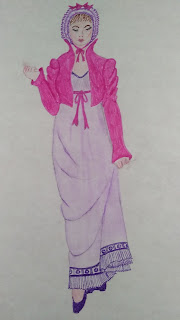
Phoebe's father and aunt insist that she have a new outfit for her wedding. For this, I made use of illustrations in Tom Tierney's Fashions of the Regency Period Paper Dolls (Dover Publications Inc 1996.) I have never gone as far as cutting these out as the book is far more useful to me in its entirety.

I chose the jacket and bodice of one design and added it to the skirt of another. The spencer jacket is rose-pink crushed velvet, the gown is lavender satin with purple trim. Her frilled bonnet is trimmed with rose-pink crushed velvet ribbon, and she wears purple satin shoes. 

Next week, I'll show you what her groom, Lord Andrew Fitzgibbon, will wear.

Thursday, January 13, 2022

What's New in 2022

 So here I am, at it again. Writing, that is. The current work in progress is Those Regency Belles Book 3, Phoebe Fisher. Here's the premise:

Phoebe Fisher’s generous dowry attracts many suitors. When they discover Phoebe’s one notable and outstanding flaw, they depart as quickly as they arrive, and she loses hope of ever finding a suitor who will love her just as she is.

After an absence of ten years, Andrew Fitzgibbon returns home to discover he is the sole heir to his deceased uncle’s title and estates, but it will take a fortune to save it. Although reluctant to press his suit to a young lady simply for her wealth, Andrew finds her intriguing and suggests a union that might suit them both. Phoebe agrees, but then events from Andrew’s past cloud their new life together.

Will these threats make or break them? Will their marriage of convenience grow into a love match, or will Pheobe never know what it is to love and be loved?

Today I'm also designing Phoebe's wedding gown. I'll show you that next week.


Saturday, December 18, 2021

Family Experiences in My Writing


This month - the last of 2021 and let's hope they all improve by leaps and bounds in 2022 - Rhobin asked: How do your family experiences translate into writing scenes?

I had to think about this topic as nothing immediately sprang to mind. What were my family experiences? After thinking long and hard, one word came to mind – movement. Nothing is static, but my family always seemed to be on the move in one way or another. Post-WWII uncles and aunts in the forces were still coming and going. Some were gone altogether, having lost their lives in that conflict.

My father, a career soldier, was demobbed but couldn’t settle in civvy street and joined the army again. Dad was posted from one Territorial Army unit to the next, and we moved every year from one married quarters address to the next. Ironically his title was Permanent Gunnery Staff Sarjeant Major to Territorial Units. Although the title was permanent, there was nothing permanent about our family life.

When Dad finally left the Armed Forces, we moved again to the job he took post-army. I moved on as soon as I could to work with horses. The next move was to my parents-in-law’s home, then into our first apartment, followed by another apartment when my then-husband took a new job. Our next move was into a new house where we stayed put for a few years. Unfortunately, that situation changed after separation and divorce. New home, here we come. We landed up in a charming but chilly 300-year old country house which was my favourite house of anywhere I have ever lived. After that came another not as old house, but a mere stripling at 100-years old.

The next move was a big one. I left England and arrived in Canada in 1990 but homes were never permanent even here. What started as a reasonably comfortable apartment in one building became inconvenient with job changes, making a move across town the sensible thing to do. Since I’ve lived in Canada, I’ve had eight moves. I never, ever imagined I’d become something of an expert in packing and moving. This movement appears in all the books I’ve written.

https://www.smashwords.com/profile/view/chathambwl


Lord and Lady Buxton from the Buxton Chronicles travel from England to California in Books 1 and 2. In Book 3 of the trilogy, Lord Buxton leaves England to fight for King and Country during WWI with all the movement that entailed.

In Book 1 of the Berkeley Square books, my first Regency series, Emmaline Devereaux has been in Spain during the Peninsular Wars, and after returning home and marrying Lord Lucius Clifton, is kidnapped and taken to France. In Book 2, Lady Juliana Beamish is on her way to India when her ship is attacked by pirates. She finds herself alone on the ocean and rescued by a captain who is on course for Jamaica. Book 3 in the series finds Lady Olivia Darnley abandoned by her mother, ultimately leaving London for the refuge of her family estate in Lincolnshire.

My contemporary Western romances have leading characters who move from one place to another. In Loving That Cowboy, Trisha Watts leaves her home in England for a vacation in Calgary during Stampede. Then, in Legacy of Love, Callie Wade moves from Vancouver to Southern Alberta. In my Canadian Historical Brides book, Brides of Banff Springs set in 1935, young Tilly McCormack makes her way from her home near Medicine Hat to Banff to work at the famous Banff Springs Hotel. In Envy the Wind, another title in the Canadian Historical Brides series and on which I collaborated with author Anita Davison, Grace MacKinnon escapes from a life of drudgery in Edwardian England and makes a life for herself in Prince Edward Island.

For my second Regency series, Those Regency Belles, Hester Dymock in Book 1 moves only a few miles from her small but comfortable home and faces much more of a journey than that. Book 2 sees Charlotte Gray having to move for her safety, and in Book 3, currently in progress, my heroine moves from her family home to that of the man she marries. That her husband has served in King George III’s Royal Navy and tells her tales of his travels makes this something of An Arabian Nights tale.

Other family experiences, which may be more family traits, are that my characters are for the most part kind, honest people. I hope those factors make them stand out a little more.

I wish you everything you wish for yourselves for this holiday season but before you go, please check out my fellow bloggers here for what family experiences they use for inspiration:


Anne Stenhouse http://annestenhousenovelist.wordpress.com

Dr. Bob Rich  https://wp.me/p3Xihq-2ue

Connie Vines http://mizging.blogspot.com/

Skye Taylor http://www.skye-writer.com/blogging_by_the_sea

Marci Baun http://www.marcibaun.com/blog/

Judith Copek http://lynx-sis.blogspot.com/

Diane Bator http://dbator.blogspot.ca/

Victoria Chatham http://www.victoriachatham.com

Rhobin L Courtright http://www.rhobincourtright.com


Saturday, November 20, 2021

The Baddie in Books


 For this month, Robin has asked us to describe a flawed or evil character we have or might use in a story. How did they become so flawed? What part will they play in the story and what will happen to them?

I always have trouble creating evil characters. I would say that most have mine have been flawed in some way rather than truly evil. Except for, maybe, Sir Peregrine Styles in my first Regency romance, His Dark Enchantress. Sir Peregrine was very much a depraved character, particularly in the satisfaction he derived from causing pain or trouble to others. He was a narcissist, manipulator, and opportunist all rolled into one character but none of that was greatly surprising given the era and the mores of the strata of society he grew up in.

People being people, and our characters are people if only in our minds and books, good and bad can come from anywhere. The best of families could have one bad apple. A family in the poorest area of town may have a dad with a heart of gold and a mum who will do anything for her children first and her neighbours after that.

People can and do change. Rose of Sharon in Steinbeck’s Grapes of Wrath spring to mind.

Circumstances can mold a person. Disappointment after disappointment may eventually turn a happy, positive person bitter and cause them to seek revenge against those he or she believes responsible. Being brought up in an abusive household may produce an abuser or someone who would never lift a finger against another person.

As authors, building the backstory for a flawed or evil character is as intriguing and circuitous as those of our main characters and, dare I say, might take a bit more of a psychological twist. Writing historical fiction means dipping into the social history of the period whether, in my case, it is the Regency or Edwardian eras. The class structure was pretty much adhered to. People ‘knew their place.’ But within that structure, the mores of the Regency became stricter through the Victorian era and began to ease again in the Edwardian era, especially the La Belle Epoch era in Europe which dated from the early 1870s up until the outbreak of World War 1.

Regency characters who held ambitions to rise above their place in society might be referred to as ‘mushrooms.’ The term ‘nabob,’ originally denoting an official under the Mughal Empire, came to be used somewhat derisively for a pretentious person, especially one growing his own wealth rather than inheriting it. After all, the definition of a gentleman then was someone who did not work for his living but off the wealth generated by his estates.

My current ‘baddie’ is one Ruby Baker in the third book, Phoebe Fisher, in my series Those Regency Belles. Ruby is a barmaid with took my hero’s promises to heart. In a drunken moment as an eighteen-year-old and about to embark on his first voyage, Andrew promised to bring her jewels from India. Ten years later, Ruby arrives on his doorstep to collect them. Why such a time span? Well, a voyage to India could take a minimum of four months. Depending on what happened during the voyage, pirates, storms, being blown off course, it could take a year. And then you turned around and possibly faced the same problems on the return journey. That was without any other detours. However, now Andrew has inherited a title and gained a wife. What will Ruby do? I’m still working on that.

Visit my fellow authors listed here and see what they are working on.

Anne Stenhouse http://annestenhousenovelist.wordpress.com

Dr. Bob Rich  https://wp.me/p3Xihq-2ue

Connie Vines http://mizging.blogspot.com/

Skye Taylor http://www.skye-writer.com/blogging_by_the_sea

Marci Baun http://www.marcibaun.com/blog/

Diane Bator http://dbator.blogspot.ca/

Rhobin L Courtright http://www.rhobincourtright.com